Retirement
Retirement Investing 101: What You Need to Know
Retirement investment is important, but many workers don’t know as much as they should about it. Learning about key retirement concepts can help you make informed decisions about retirement.
Risk tolerance, diversification, and asset allocation are concepts vital to retirement investing. Knowing how much and where to invest is important.
Educational resources are available to learn more. Employers or financial professionals can also help.
Retirement investments and savings act as vital sources of income after Americans leave the workforce. However, according to a survey from Transamerica Center for Retirement Studies (TCRS), 62% of workers employed at for-profit companies agree they don’t know as much as they should about retirement investing.1
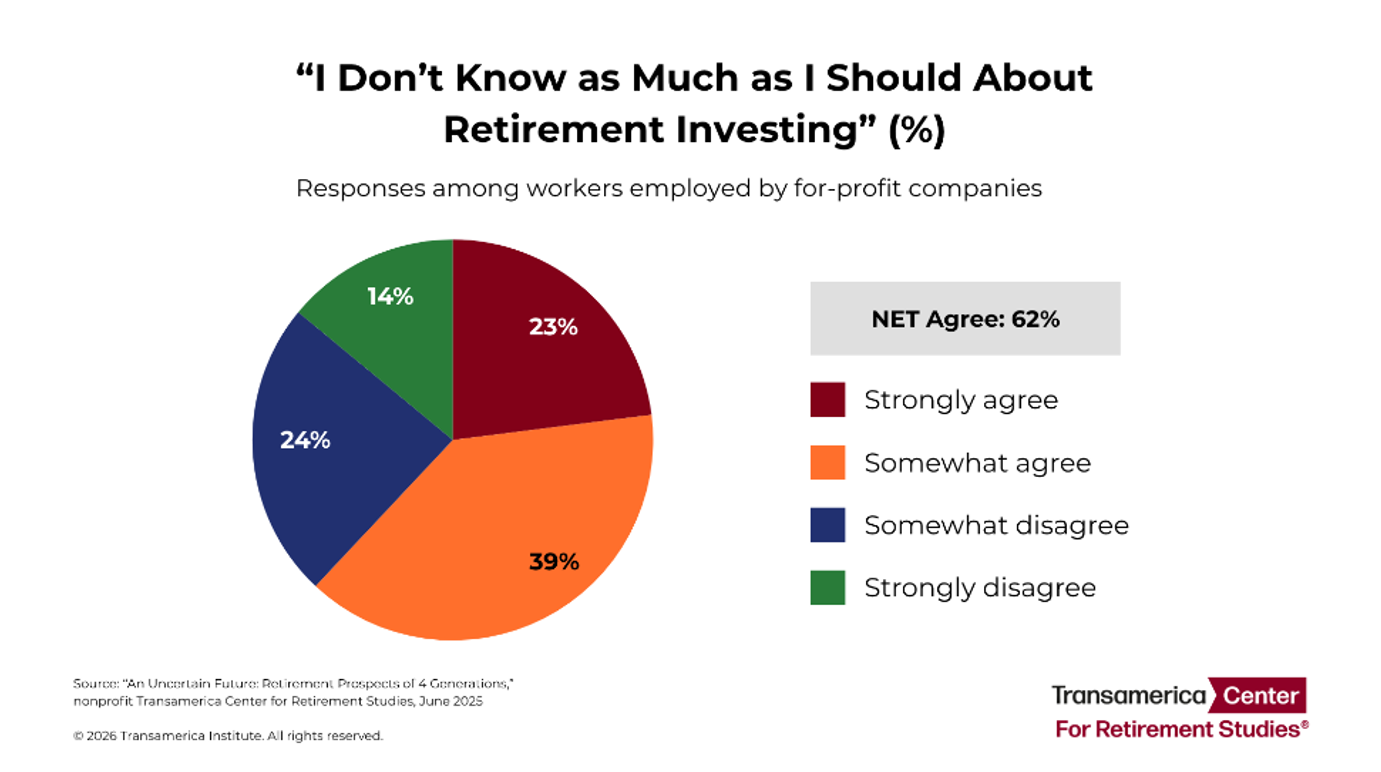
This reflects how complex retirement investing can feel. Terms like asset allocation, risk tolerance, diversification, and rebalancing may seem complicated, but learning about them can help you invest intentionally.
Whether you are just starting to save or have already started investing, this information can help you.
Why Retirement Investing Literacy Matters
Most workers are funding their own retirement. Employers sometimes manage investments for workers, but this is becoming less common. Many of today’s retirement plans require workers to make their own investment decisions.
This makes financial literacy more important than ever. Yet according to research from Transamerica Center for Retirement Studies only 11% of workers have “a great deal” of understanding about asset allocation principles as they relate to retirement investing.1 If you don’t understand investing, you may be taking on more risk than you realize. You might also not have enough risk to meet your goals.
Understanding key concepts, such as risk tolerance, diversification, rebalancing, and professional resources, forms the foundation of smart retirement investing.
Risk Tolerance: Know Your Comfort Level
Risk tolerance is your ability and willingness to accept the possibility of losing some or all your investment funds in exchange for potential gains over time. Consider the question: How would you feel if your retirement account lost significant value next month but made greater gains in the future?
You may approach risk differently. An aggressive investor has high risk tolerance and is comfortable accepting short-term losses for the possibility of higher payoffs later. A conservative investor has low risk tolerance and prefers steadier, more predictable returns. They are more focused on maintaining what they’ve already saved.
The main factor that determines your risk tolerance is your time horizon, which is the amount of time you plan to hold an asset to reach your goal. This is often based on the age you start investing and the age you plan to retire. If you have a longer time horizon, you can theoretically take on more risk. If you have a shorter time horizon, then you might take on less risk.
Understanding your risk tolerance is the first step to making any investment decisions. It informs how your money should be allocated and when you might need to adjust.
Diversification: Spread Out the Risk
You have likely heard the phrase “don’t put all your eggs in one basket.” In investing, that idea is called diversification, and it’s one of the most practical tools available to everyday investors.
Diversification involves spreading your money across a range of different investments, types of assets (such as stocks, bonds, and cash), and different industries. The goal is to reduce the impact of an investment performing poorly by cushioning your losses with investments in other areas. If one stock drops sharply, a well-diversified portfolio has other holdings that may hold steady or even grow, helping to offset that loss.
It’s worth noting how diversification relates to, but differs from, asset allocation. Asset allocation is how you decide the overall mix of your portfolio, such as how much goes into stocks versus bonds versus cash, based on your risk tolerance and time horizon.
Diversification ensures you’re not overly concentrated in any one area. In other words, asset allocation is the big-picture strategy, and diversification is how you put that strategy into practice. Together, they help you manage risk without having to give up growth potential.
Rebalancing: Stay on Track Over Time
Even well-planned investments change over time. Some grow faster than others, which can shift your balance of investments in ways that don’t reflect your goals or risk tolerance.
Rebalancing is the process of returning your portfolio to its original asset allocation and realigning with your risk tolerance. For example, if stocks perform strongly, they may become a larger share of your portfolio than intended. This could expose you to more risk than planned, even without making any changes.
It is typically best practice to review your investment portfolio on a regular basis. Many financial experts recommend reviewing every six to 12 months. Some investors prefer to rebalance on a set schedule. Others rebalance only when a particular asset shifts beyond a certain mark. Either approach can work. What matters most is that you check periodically and adjust when needed, rather than setting your portfolio once and forgetting about it.
Before rebalancing, it’s also worth checking with your plan provider or tax advisor, as some methods may have transaction costs or tax implications.
Explore Your Resources
Managing retirement investments can feel overwhelming, and many workers share that sentiment. According to research by Transamerica Center for Retirement Studies, 58% of workers agree they would prefer to rely on outside experts to monitor and manage their retirement savings plan.1
Three practical paths forward include:
- Do it yourself. If you prefer a hands-on approach, there are useful educational resources available for free.
- The U.S. Securities and Exchange Commission’s investor education website at www.sec.gov offers a Beginner’s Guide to Asset Allocation, Diversification, and Rebalancing.2
- Use your employer plan’s resources. Many 401(k) plans already offer tools and services designed to take many of the assumptions out of investing. These may include:
- Managed account service: makes investment or allocation decisions for you
- Model portfolios: use the funds in the plan lineup to meet your target retirement date and/or risk tolerance profile
- Personalized target date fund: factors age, income, contribution rate, company match, savings balance, and target retirement year
- Target date funds: designed to change allocation percentages for you as you approach your target retirement year
- Strategic allocation fund: designed to address your specific risk tolerance profile
- Work with a financial professional. A licensed financial advisor can help you evaluate your full financial picture and create a retirement investment strategy that is tailored to your goals.
- The Financial Industry Regulatory Authority offers investor education tools and a free resource called BrokerCheck at www.finra.org, which lets you research the backgrounds of financial advisors and brokers.3
Take the First Step
Retirement investing doesn’t have to feel out of reach. Concepts like risk tolerance, diversification, and rebalancing may seem daunting at first, but they become much more manageable once you understand the basics. A single step today toward understanding how your retirement savings are invested is a step closer to your retirement goals.
Start this week by logging into your retirement account and reviewing how your savings are currently invested. From there, explore what resources your plans offer, or visit www.sec.org or www.finra.org to learn more — at your own pace.
Your retirement security is worth the investment of a little time and curiosity.
- Transamerica Center for Retirement Studies. An Uncertain Future: Retirement Prospects of 4 Generations. June 2025. pp. 114, 115, 123 https://www.transamericainstitute.org/docs/research/generations-age/uncertain-future-retirement-prospects-four-generations-survey-report-june-2025.pdf?sfvrsn=1d68df40_7
- U.S. Securities and Exchange Commission. Beginner’s Guide to Asset Allocation, Diversification, and Rebalancing. https://www.sec.gov/about/reports-publications/investorpubsassetallocationhtm
- FINRA. BrokerCheck. https://brokercheck.finra.org/
- Financial Literacy
- Retirement